
When dairy is your proving ground: how 3D vision turned a messy problem into an automation opportunity
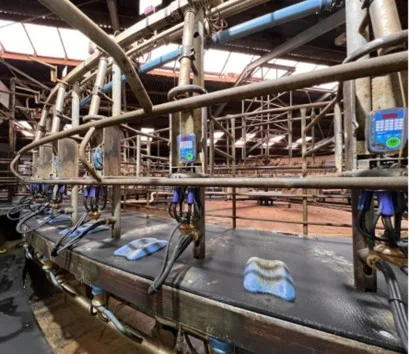
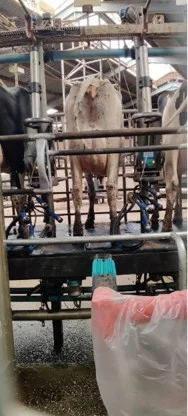
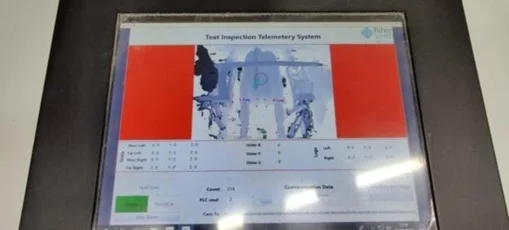
For many manufacturers, machine vision means one thing: a camera on the line that says “good” or “bad” and moves on. That’s useful, but it’s also only the start. At Fisher Smith we’ve been pushing that boundary by applying industrial 3D vision, AI and robotics to problems most people assume are too messy or too delicate for automation. One of the most striking examples is a live dairy installation where we automated pre-milking teat cleaning on a rotary parlour. The dairy job is the proof; the lesson is that if a system can handle live animals in muddy, wet, variable conditions, it will perform anywhere.
Why dairy is a tough test case (and why that matters)
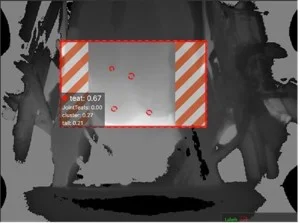
Barn environments throw everything at a camera: dust, moisture, organic debris and constantly changing geometry as animals move. The requirement was simple on paper: consistent, regulation-compliant teat cleaning before milking, but fiendishly hard in practice. To solve it we combined a rugged time-of-flight 3D camera with a deep-learning pipeline and a six-axis robot. The 3D data gives accurate X-Y-Z coordinates of each teat so the robot can position cleaning nozzles with repeatable precision. That level of robustness is what makes the solution credible.
As Reece Donneky, Project Engineer at Fisher Smith, puts it:
“It was uncomfortable and dirty work at times with days spent under the carousel adjusting cameras and wiping mud (and worse!) off lens shields. That hands-on testing proved the system would work reliably in the real world.”
Real testing like this is what differentiates lab demos from deployable systems.
What we actually built (short version)
- An IP67-rated 3D ToF camera producing HDR depth maps.
- A custom interface and processing pipeline to extract teat coordinates in real time.
- A robot control loop that uses those coordinates to guide cleaning nozzles safely and repeatably.
- On-site calibration, automated lens cleaning, and field validation to meet hygiene rules.
The result is automated cleaning that meets hygiene standards, reduces manual labour and gives consistent coverage on every animal, every shift, every day.
Why the dairy story is useful for other industries
It’s tempting to see this as a dairy-only story. In truth, dairy is a credibility vehicle. The real message is transferability. If 3D vision and AI can reliably locate and interact with soft, moving, reflective, dirty objects, it can support automation in other organic or unstructured contexts:
- Food processing: locating variable produce for cleaning, grading or packing.
- Agriculture: autonomous weeding, fruit picking or body-shape recognition for health checks.
- Waste and recycling: identifying deformable items in conveyors where shape and reflectivity vary.
- Medical device and biotech R&D: handling irregular components where traditional fixtures are impractical.
Proving performance on cows means the bar for “difficult” in other sectors is already lower. It’s evidence you can safely show technical teams and procurement, not just marketing.
Lessons for anyone thinking of applying vision in organic environments
From our experience on the dairy project there are some practical rules worth sharing:
- Start with rugged hardware. Use IP-rated cameras and plan for routine lens cleaning.
- Treat 3D as spatial data, not just pictures. Depth maps change how robots can be controlled and how anomalies are detected.
- Use AI where rules fail. Deep learning excels at generalising from varied examples (for example, distinguishing teats from tails); but for geometric checks, traditional tools still win.
- Validate in situ. Nothing substitutes for running the system exactly where it will be used - real animals, real lighting, real dirt. Reece’s quote above is a reminder of that reality.
Want to see it in action (or test an idea)?
We’re happy to talk through how the dairy solution maps to other problems. If your process involves irregular shapes, organic surfaces, poor lighting or moving targets, the lessons from the parlour are directly applicable. We can help scope a proof-of-concept, test samples in our lab, or design a pilot installation that proves value before large capital outlay.
Machine vision is not just a gatekeeper, it’s a sensor that can feed your automation with the information it needs to be smarter, steadier and more scalable. The cow cleaned on our carousel is simply the most dramatic demonstration of that fact. If that sounds like a problem you’d like solved, get in touch and we’ll talk through what a trial looks like.
Talk to us today about how Fisher Smith can help you with a handheld machine vision solution. Click on the button below to contact us.