Finding the perfect match: Valentine’s for automation
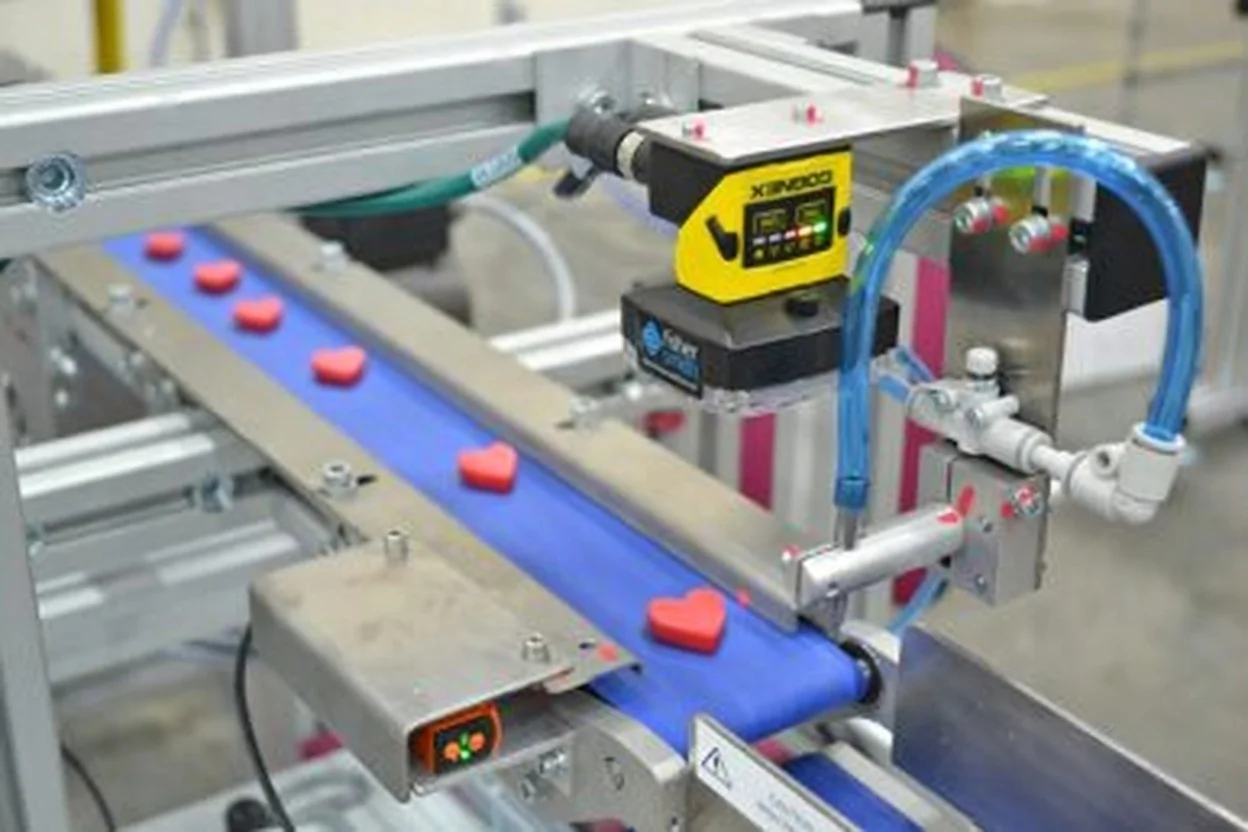
At the risk of stretching an analogy, but in recognition of Valentine’s Day, here’s our attempt to link machine vision systems with romance. Please forgive us!
Remember when you first fell in love? You exist in a happy state, looking forward to your next date and with a smile permanently affixed to your face. Life is good.
Finding a machine vision system is never going to hit those heights, but because a good match makes everything easier and a poor one creates constant friction, there are definitely parallels. For production engineers and operations managers, the question isn’t “what’s the fanciest camera?”, it’s “what will reliably solve this problem on my line, day after day?” A long-term relationship is the most rewarding.
This Valentine’s Day we’re setting sentiment aside and offering a practical guide to matching vision systems to real factory problems. The aim is simple: help you avoid expensive mismatches and find a long-term solution that not just smells of roses, but blossoms over time.
Start with the problem, not the product
Too often projects begin with a product in mind and end up shoehorning that product into an unsuitable application. Instead, begin with a precise statement of the problem:
- What exactly do you need the system to detect or measure?
- What are the environmental conditions (lighting, dust, vibration, temperature)?
- What is the required throughput and acceptable latency?
- What are the integration constraints (space, PLCs, HMI, safety)?
Being exact here saves time and money. A camera that reads barcodes well on a clean label may fail on reflective, curved packaging. A deep-learning model that excels in a controlled lab can struggle on a high-speed conveyor with changing backgrounds.
Signs your current or proposed solution is a poor match
Watch for these warning signs during scoping or early trials:
- Frequent false rejects or misses under real production lighting
- Constant re-calibration after small process changes
- Large differences between lab demo performance and on-line results
- A bespoke mechanical fix is required to make the vision system work
- Long commissioning times and repeated change requests from integrators
If you see one or more of these, the likelihood is that the system, optics, lighting or software weren’t chosen for the actual environment.
What “good fit” looks like
A matched solution typically combines several elements chosen for the task:
- Correct optics and field of view for the object size and working distance
- Lighting designed for the specific surface characteristics (polarised, ring, dome, coaxial)
- Sensor choice (2D, 3D ToF, SWIR, multispectral) driven by the material and task
- Software approach aligned to the inspection: classical tools for geometric checks; deep learning for pattern variability or natural organic materials
- Integration footprint that fits the machine, plus maintenance and remote diagnostics planned in
A good outcome is not just a workable inspection, it is repeatable throughput, low maintenance and clear, auditable results.
A practical checklist for the right match
Use this checklist to evaluate a proposal or scope a project:
- Define the failure modes: what counts as a pass/fail and why?
- Environment audit: measure light levels, speed, vibration and contaminant risk.
- Sample testing: run representative samples in our lab under real-world lighting.
- Optics and lighting spec: choose lens, magnification and light type for the surface.
- Sensor selection: confirm 2D vs 3D vs spectral needs.
- Software fit: rule-based tools or deep learning? Which gives traceable results?
- Integration plan: PLC, HMI, data capture, and fallback procedures.
- Pilot and validate: short pilot online with agreed KPIs (read rate, false reject, uptime).
- Support and change control: who does updates, retraining and remote diagnostics?
- ROI and lifecycle: estimate savings, uptime improvement and ongoing support costs.
This sequence turns hopeful demos into predictable projects.
When to use AI… and when not to
Deep learning is powerful, but it’s not a fix for poor optics, inadequate lighting or unrealistic expectations. Use AI when you need the system to generalise across variable appearances (blemishes on complex shapes, organic produce, reflective components). Use classical vision for precise geometric measurements and standards-based grading (for example ISO barcode verification). Often the best systems combine both approaches.
Proof over promise
We encourage potential customers to ask for lab trials, not just slides. Bring real parts, process samples or even a short video of the line during peak shifts. A two-day lab test will expose issues that a half-hour on a demo stand will not. We’ve seen time and again that a modest amount of early testing prevents months of rework.
Make the relationship last
Even a perfect match needs attention. Expect to plan for routine checks, lens cleaning, retraining AI models when materials change and a support pathway for software updates. These are the maintenance tasks that keep a system delivering value, year after year.
If you’re thinking about a new vision project, or you’re stuck with a system that’s never quite lived up to the demo, get in touch. We’ll run a quick scoping call, propose a lab test and show you how to find the right match on the first try. No roses, no hype, just reliable automation that fits your line.
Contact us to book a scoping session and let us bring a little more love into your automation decisions.